Growing Down
The soul must take root.
An acorn can only become an oak.
But even an oak must first find soil.
The soul must come down
When we think of development, we almost always think of moving upwards.
Growing. Rising. Improving. Achieving success. Surpassing yourself. Becoming more. Becoming bigger. Becoming freer. ‘Becoming the best version of yourself’.
It’s no coincidence that in English, an adult is called a ‘grown-up’.
But what if the deepest movement of a human life isn’t upwards?
What if your soul doesn’t need to go up, but down instead?
What if the intention isn’t for you to rise above yourself, but to finally descend into yourself?
Then we must turn the tree of life upside down.
In some ancient traditions, that tree of life is indeed depicted upside down. Think of Kabbalah and the Bhagavad Gita. Its roots do not lie down in the earth, but up above, in heaven, in the unseen, in the origin.
The branches grow downwards, into the world. Towards matter. Towards time.
Towards the body. Towards history. Towards people. Towards action.
The soul does not come to earth as a blank sheet of paper. It comes with an image. A direction. A mysterious form that has not yet taken shape.
An acorn can only become an oak. Nothing else. Not a beech. Not a willow. Not a spruce, nor a pine. In the tiny acorn, the oak is nowhere to be seen yet, and yet it is already there. As a premeditated plan, in the mind, as an inner necessity.
That is another way of looking at a person. Not merely as a product and end result of upbringing, environment, trauma, genes or mere chance. But as someone who brings something with them. An original form. An inner vision. A calling. A genius. A daimon. The psychological task, then, is not simply to grow.
The task is: growing down. Descending. Landing. Grounding. Becoming real.
Not fleeing from life, but delving deeper into it.
The daimon
The ancient Greeks had a word for the inner companion who, according to many myths, fairy tales and stories, is born together with a human being:
the daimon. Not a demon in the later, sinister sense. But a guide.
A voice. A call. Or a calling.
An inner presence that knows why you are here, even when you yourself have forgotten. According to the myth, before birth the soul chooses an image and a destiny. Afterwards, it drinks from the river of oblivion.
We come into the world and forget why we came.
But the daimon does not forget. It keeps calling.
Not always kindly. Not always clearly. Not always at a time that suits us. Sometimes it calls through desire. Sometimes through talent. Sometimes through jealousy. Sometimes through dreams. Sometimes through symptoms. Sometimes through coincidences that can no longer be mere coincidence. Sometimes through crisis. Sometimes through a persistent feeling:
this life isn’t quite right yet. The daimon is that part of you that refuses to be fully conformed. You can ignore it. You can numb it. You can drown it out with success, status, work, possessions, opinions, haste or perfect behaviour.
But it does not disappear.
For what is not lived seeks another way in.
That is why ‘growing down’ does not begin with a method.
It begins with recognition.
Gate 0 — Recognising what calls to you
I call it ‘becoming what you are’ within SelfSo and BRON, after Alan Watts’ book. And James Hillman developed this into the Acorn theory. The idea of the daimon stems from the ancient Greek philosophers Plato and Socrates. But it amounts to the same thing, and the unconditional prerequisite before a person can truly delve into their life is clear. We must first recognise that there is something living within us. Something unique.
Something that cannot be reduced to a diagnosis, a character trait, upbringing, trauma or social functioning.
And there must be someone who says: I see it. Who says: I see you.
I see what wants to live through you. I see the form that has no form yet. I see the oak in the acorn.
That recognition is not a compliment. It is something greater. It is an act of seeing.
Sometimes that recognition comes from a teacher, a friend, a loved one, an artist, a mentor.
Someone who looks not only at what you do, but at who you are.
Someone who sees the beauty in something that you yourself may barely see or dare to believe in.
After that, you can recognise and acknowledge it within yourself. This is the essential gateway 0.
.
The acorn requires a mentor.
BRON (source)
The acorn needs someone who can sense the tree. Within BRON, that is my role. Not as a therapist following a set protocol. Not as a coach ticking off goals. Not as a teacher working through a pre-agreed programme. But as a mentor, artist and dream reader. Someone who listens to the image beneath the story.
Who is the person beneath the role they’ve learnt to play?
Who were you before the world told you who you had to become?
What image has been trying to live through you your whole life?
Only when the daimon is recognised does it need to prove itself less strenuously. Then it no longer needs to bang on the door solely through exaggeration, destruction, a thirst for fame, status, panic or symptoms. Then the descent can begin. Recognition and acknowledgement are therefore essential in order to grow and to be able to descend.
Growing down
Growing down means not only recognising your calling, but giving it weight, form, place and responsibility in this world.
But be careful.
The daimon is often unearthly at first. Absolute. Demanding.
Childish. Grand. Sometimes even megalomaniacal. It wants everything at once. It wants it now. It won’t wait for money, age, a body, duties, relationships, the market, administration or gravity. The daimon sometimes becomes a demon that takes over everything. For a calling that remains only in heaven becomes dangerous. It becomes fantasy. Self-glorification. Frustration. An eternal promise.
A magnificent tree that never touches the earth.
‘Growing down’ makes the calling human. The soul must come down to earth.
Into a body. Into a lineage. In a place. In circumstances.
Into an action.
These are the four descents.
1. Body. The calling takes on real weight
The first descent is into this body. Not into the body you would have liked to have.
Not into the ideal body. Not into the body of the past. Not into the body that society constantly projects:
young, toned, powerful, available, malleable. This body. With its age, vulnerability, rhythm, desires, limits. With its breath. Pain. Beauty and gravity.
Look around you. Look at television, social media, advertising, the streetscape. How much resistance is there to one’s own body? How many people try not to inhabit their bodies, but to escape them? To appear younger. To appear stronger. To appear smoother. To appear unaffected.
To look like someone else.
A uniform perfection that rejects all individuality.
But the soul cannot take root in a body that is constantly rejected. The body is not merely a vehicle through which the daimon carries out its plans. The body is the first reality to which the calling must submit. The heavenly image must be given hands.
Feet. Voice. Breath. Rhythm of work. Rest. Boundaries. Gestures. Presence.
A singer needs a throat. A painter, a hand. A speaker, a chest.
A writer, a nervous system capable of carrying the images. A beloved, skin.
A mentor needs a body that can remain present with what the other does not yet dare to see.
That is why physical signals are not merely disruptions. Symptoms do not primarily belong to illness, but to fate, to destiny. To your daimon. Of course, a body can fall ill. Of course, illness sometimes requires medical attention. But a symptom can also carry a question.
An image. A direction. A boundary. A refusal.
A truth that has not yet found its voice.
Not every symptom is therefore an enemy.
Not every crisis is a collapse.
Not every deviation is a deficiency.
But the body that says: ‘This far and no further. Not in this way. Listen. Turn back. Become real.’
BRON questions:
1. How does your calling seek to live out its purpose in this very body?
2. What form can your inner vision take only through your body?
Watch the video explaining what the Acorn Theory is and why it’s important.
2. Parents and background. Becoming one with your people
The second descent takes us through parents and background. But not in the way our society often talks about it.
We are not merely the result of what our parents did right or wrong. We are not solely the product of upbringing, trauma, environment, background or family dynamics. That is too narrow a view.
Of course, parents matter. Of course, a family leaves its mark. Of course, there may be pain, deprivation, violence, shame, absence or confusion. But ‘growing down’ requires something other than endlessly explaining who you are in terms of what has been done to you.
You are not your trauma.
The question shifts. From: What have my parents done to me?
To: Why did this particular view of life have to come into the world through these people?
Why this father? Why this mother? Why this name?
Why this family? Why this language? Why this rupture?
Why this legacy? Why this wound?
That doesn’t mean you have to make excuses for your family. Nor does it mean you have to forgive or understand everything.
And it certainly doesn’t mean that dead people should still be blamed for everything you’re not living now. (Family constellations)
It means taking your place in the tree.
Including the crooked branches. The damaged branches. The rotten branches. The blossoming branches. The branches nobody wanted to see.
You are one of your people. And you are also the one who stands apart from them. You carry the legacy a little further, but you do not repeat everything. Perhaps something entered the world via your family that had not yet found its proper form. Perhaps you did not come to continue the old story, but to finally carry it in a different way.
BRON questions:
1. What came into the world through your family that only you can carry forward?
2. In what ways are you like your family, and where does your own identity begin?
3. Place. Actually settling down somewhere
The third step is place. A soul must have a home. Not just symbolically. But literally, too. In a house. A room. A studio.
A city. A landscape. A community. A craft.
A concrete world with neighbours, streets, obligations, habits, seasons and limitations.
Many people live as if real life begins elsewhere. Later. When there’s more money. When the right place comes along. When the right people turn up. When things calm down. When everything falls into place. ‘Soon I’ll do what I really want to do; soon, after I retire, I’ll take photographs, paint, travel.’ ‘Soon I’ll do what I feel is right.’
But ‘growing down’ is the opposite of remaining perpetually on the move towards the place where you’ll finally begin.
The daimon must take root somewhere.
A place that suits your soul isn’t just a place where you feel inspired.
It’s also a place that demands something of you. A place where you become accountable. Where you don’t just receive, but also take care.
An inspired place isn’t always easy. Sometimes it binds you. Sometimes it confronts you. Sometimes it demands care, loyalty, patience, repetition. But it is precisely through this that your calling becomes real. Without a place, everything remains a possibility. With a place, form begins.
BRON questions:
1. Where can your vision take root?
2. What obligations does that place entail?
So not just: where do you feel free? But also:
Where do you want to stay when the work calls?
Where do you take responsibility?
Where does your presence become part of the world around you?
4. Circumstances. Giving back to the world
The fourth descent is the decisive one. The soul only truly finds its place when one’s calling ceases to be merely a source of personal fulfilment and becomes a matter of reciprocity. What you have experienced, received, lost, learnt, carried or developed must one day take a form that holds meaning beyond yourself.
A gesture. A work. An act. A book. A song. A business.
A conversation. A garden. A child. An organisation. A stage.
A choice. A way of being present.
The question is not merely: What do I want to get out of life?
But: What does life ask me to give back?
That is an entirely different movement.
Self-development can still revolve around the individual: my talent,
my destiny, my desire, my growth. ‘Growing down’ goes further.
It requires that your unique form becomes part of the world we inhabit together. Your calling must not merely shine. It must serve.
Not sacrifice. Not obedience. Not putting yourself last.
But as the natural fruit of who you are.
A tree does not eat all its own fruit.
It provides shade. Oxygen. Wood. Leaves.
Fruit. A place to nest. Memories.
Landscape.
In the same way, a human life becomes truly real when it gives something back.
This text, and I myself, have been inspired by the Acorn Theory and the concept of ‘growing down’ from the work of James Hillman.
And the pioneering work of Carl Jung and Alan Watts.
This is where we get to the heart of SelfSo and BRON. To my life mottos:
You are what you do. And: The answer lies in creation.
Because existence without form remains invisible. The soul needs a gesture to manifest itself in the world.
BRON questions:
1. What is life asking you to give back?
2. What work, what gesture or what action makes your connection to this world visible?
The movement of BRON
Gate 0 — Recognition
What image has been trying to live through you your whole life?
1. Body — Embodiment
How does that image acquire hands, feet, a voice, rhythm and boundaries?
2. Origin — Belonging
How does your unique life belong to these people and this history?
3. Place — Rooting
Where can the life that belongs to you truly take place?
4. World — Giving Back
What must you create, do, serve or pass on? That is the true depth of BRON.
I don’t just help people find their acorn. I help ensure that the acorn does not remain a lofty fantasy about itself.
A lovely thought. A dream without grounding. A destiny without action. The soul must not merely be remembered.
It must take root. You help the tree take root in the earth.
Become what you are
‘Growing down’ is the process of making the original image with which you were born visible, physical, local and service-oriented.
That is different from personal growth. Personal growth can get bogged down in improvement. In development. In becoming more. In endless reflection. In courses, insights, diagnoses, explanations, intentions and plans. But the deepest question is simpler and far more difficult:
How does that which only you can be become part of the world we inhabit together?
That is BRON. That is also what my books are about. And my work with organisations. And Droommachine.
And Art for Organisations. And yes, of course, my guitar.
They are different gateways to the same movement:
making the inner image visible, audible and usable for others.
‘Become what you are’ means finally giving form to what you already are at your core.
Not upwards, away from life. But downwards. Into the body.
Into history. Into the place. Into the action. Into the world.
That is where BRON begins.
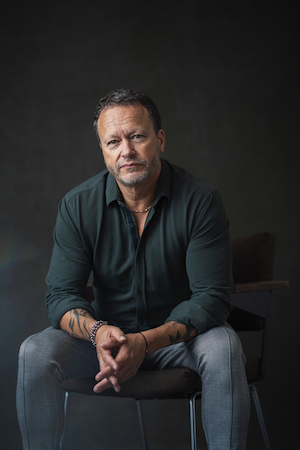
About Erwin Steijlen
Erwin Steijlen is an artist, composer, guitarist, speaker, author and founder of SelfSo.
Through BRON, he helps people listen to the image that has been trying to live through them their whole lives.
Through Droommachine, he explores dreams as the language of the soul: not to reduce them to a simple explanation, but to reveal what is waiting to be heard in everyday life.
His work moves between dreams, art, music, poetry and action in a single flow: becoming who you are.
His third book, Dromer zoekt BRON, is due to be published in late 2026.
Take a free dream analysis with Droommachine
Do you feel that something within you has been calling out for some time, but has not yet taken shape?
In BRON, we explore together which image is trying to speak through your life, via dreams, the body, desire, crisis, chance and action.
Not to become someone else.
But to become who you are.