Dromer Seeks BRON
A work of literary nonfiction in novel form.
A work of literary nonfiction
in novel form.
What happens when the dreams you dream at night
become the life you live in daylight?
What happens when the dreams
you dream at night
become the life you live in daylight?
About the Book
Dromer Seeks BRON is a true story about what happens when someone stops organising his life around achievement, safety, recognition and borrowed desire, and begins listening to the person beneath the role he has learned to perform.
It begins with two disturbing dreams and one decision: for one year, Dromer will take the language of the night as seriously as the language of the waking world, and act on what it asks of him.
That decision changes everything.
Dreams begin to cross into waking life. Music seems to answer questions, synchronicities accumulate, a silent boy appears in a cave, and eventually Dromer builds Droommachine, a digital interlocutor for dreams.
The book takes dreams seriously as part of human reality. It records what happened when one man decided to live by what they asked of him.
He thought he was writing a book about dreams.
Slowly, the book began to write him back.
The story determines its own form
Dreams, music, poetry, mythology, AI, illness, synchronicity and lived encounters appear because the journey itself demands them. The book lives beneath those categories, in a more fundamental question:
What shapes a human life, and what happens when we begin to listen to what was there before achievement, expectation and the roles we learned to perform?
Watch the Film
A cinematic reading of the first 4 chapters of
Dromer Seeks BRON ·
(headphones work best)
The Story
Dreams did not lead him away from reality.
They returned him to it.
Dromer is a Dutch composer, poet and artist whose carefully constructed identity has begun to fracture. After two unsettling dreams—one in which a snake emerges from his body, another in which a spider tries to enter it—Dromer makes a radical decision. For one year, he will stop treating dreams as meaningless remnants of the night. He will listen to them as a language: one that may know more about the purpose of his life than he does.
That decision changes everything.
Dromer meets Peter, a seriously ill man whose body is tormented by violent, uncontrollable spasms. Medicine offers examinations, diagnoses and medication, but no explanation that reaches the centre of his suffering. Dromer begins to wonder whether Peter’s body is not simply failing, but trying to speak. A friendship develops between them. Their histories, fears and dreams become entwined like threads in a web. Behind Peter’s symptoms, Dromer encounters grief, shame, inherited loyalty and an identity built around control, achievement and the gaze of others. As he tries to understand what Peter’s body may be carrying, Peter becomes a mirror for everything Dromer himself has sacrificed beneath ambition and the demands of contemporary life.
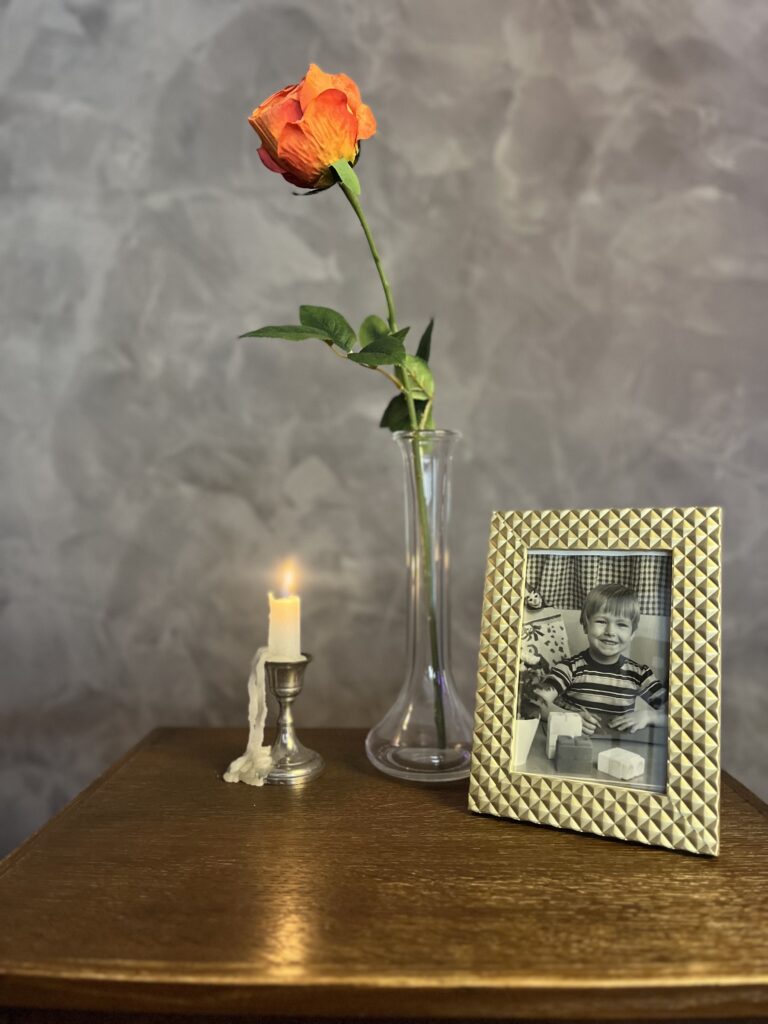
Their search eventually leads beyond conversation and interpretation. Together, they create a ritual through which Peter addresses what his body appears to have been carrying. Afterwards, the violent spasms that have ruled his life fall silent. Meanwhile, the boundary between dream and waking reality grows increasingly porous.Images from the night begin to return during the day. A spider from a dream appears above Dromer in his bathroom. Songs seem to answer questions he has not spoken aloud. The year 1977 surfaces with uncanny persistence. Animals, insects, words and objects arrive at strangely precise moments. A rose returns again and again, as though it is following him, or perhaps showing him the way. Dromer begins to suspect that thoughts and images do not remain confined to the mind. They can acquire lives of their own in the waking world.
During a walk, he returns to the abandoned rehearsal building of his youth. Beneath it, in a cave-like studio that should not exist, he encounters a silent young guitarist. The boy offers no explanation and speaks no words, yet reveals what Dromer surrendered when he adapted himself to ambition, success and the expectations of the world: his fire, his instinct and the pure necessity to create. As the year unfolds, more people come to Dromer with dreams, illnesses, relationships and lives that no longer fit. Without setting out to become one, Dromer slowly becomes a guide to others.They begin to see him as a coach, therapist or healer—identities he strongly resists. He is an artist. He has spent his life composing music, writing poetry and making invisible emotions tangible. Why should he now become something else?
In search of answers, Dromer builds Droommachine: a digital dream interlocutor shaped by Jungian psychology, mythology and symbolic thought. It becomes part mirror, part opponent and part unexpected companion. Through conversations with the machine, with Peter, with his wife Lin, with strangers and with the images of the night, Dromer begins to understand how ambitions, roles and desires can be absorbed from parents, partners, rivals, markets and entire cultures. He calls this infected desire.
Bodies freeze. Relationships become prisons. People sacrifice themselves to lives they never consciously chose. Depression, burnout, addiction and physical pain begin to appear not only as private disorders, but as responses to identities the human being can no longer inhabit. At the same time, the established world offers Dromer little confirmation that his new direction has value. Familiar doors remain closed. His work is rejected, his transformation is misunderstood, and financial pressure urges him back towards the successful life he already knows. He must choose between translating himself once again into a form the market recognises, or remaining faithful to something that does not yet have a name. Slowly, Dromer realises that he has never abandoned his path as an artist.
Music has always allowed him to hear what lives beneath language. Poetry has always given form to what reason cannot yet grasp. Dreams are not leading him away from his work. They are revealing its deepest purpose. Art and psychology were never separate worlds, but different languages describing the same human reality.
Dromer cannot save Peter or complete Peter’s journey for him. He can only meet him, see him and remain present while Peter searches for a life he can inhabit as himself. The same is true for Dromer. He must stop waiting for the new land to reveal itself and begin building it.
Droommachine becomes real. SelfSo becomes real. BRON becomes a place where people arrive with dreams, grief, choices, recurring patterns and bodies that no longer wish to cooperate with the lives imposed upon them. Dromer does not become the therapist or coach he feared becoming. Nor does he return to the artist he once was. His former and present worlds converge. Music, poetry, philosophy, psychology, mythology and dreams become part of a single artistic practice.
He thought he was writing a book about dreams. Slowly, the book began to write him back. The dreams were never asking merely to be interpreted. They were asking to be lived.
What began as a crisis becomes a vocation. What began as a dream becomes an act. And the new land Dromer had spent years searching for becomes the land he must now build.
That land is called BRON.
About the Author
Erwin Steijlen is a Dutch composer, author, poet and audio storyteller whose work explores identity, emotion and the hidden forces that shape human lives.
He previously wrote Corporate Music Method and Waartijd. In Dromer Seeks BRON, his life as a composer and artist converges with everything he has learned about human behaviour, philosophy, psychology, mythology and dreams. Rather than presenting these ideas as theory, he transforms them into a work of art.
For more than twenty-five years, Erwin has created music and sound for international brands, artists and productions, including BMW, Volkswagen, Netflix and Cirque du Soleil. His work has always begun beneath the surface, searching for what a person, story or organisation is truly trying to express.
Over time, his attention shifted from the identity of organisations to the human being beneath the assumed role. That same inquiry led him to found SelfSo, Droommachine and BRON. Through BRON, he now works one-to-one with people around dreams, recurring patterns and life questions.
Dromer Seeks BRON brings all these strands together. Written, narrated, composed and performed by Erwin,
the work extends beyond the page through film, music, poetry, spoken word and the stage.
Based in Tilburg, the Netherlands · Working internationally
From page to sound
After a dark night in which Lin broke down, Dromer wrote a poem and transformed it into music.
JUST LIKE THE FIRST TIME
Available material
The following material is available to download.
Synopsis.
Text behind the film
- Snake
- Fingers
- Spider
- Mirror
DOWNLOAD text behind the film
Selected Chapters
- Letter to a friend
- Frozen Love
- The Encounter
- 1977
- Winners
- New Land
CONTINUE READING
Résumé & Selected Credits
Books, international projects, professional experience and selected credits.
DOWNLOAD RÉSUMÉ
Publishing & Representation
The complete English manuscript is available upon request.
For manuscript requests, representation and publishing conversations:
erwin@selfso.nl
+31 626 37 43 56
Somewhere at the frontier lies a land,
and its name is BRON.
Hidden from view,
small, yet singing strong and true
beneath the sun, between old kingdoms,
lies a place where people meet.
And when they greet,
they speak these words:
I see you.
I see you.
As you were born, so may you live.
Your truest self is what you have to give.
No emperor’s clothes, no borrowed part.
Here, everyone lives for love and art.
No middle ground where you can hide.
No war for image, mask, or pride.
No longing to become someone else.
No role to play.
Somewhere at the frontier, I build a land.
You are welcome, just as you stand.
That land is called BRON.